From Bethlehem to Your Home: The Story Behind Hand-Carved Olive Wood

Some things feel different the moment you hold them.
Not because they are expensive. Not because they are trendy. But because they were made with care, by real hands, over real time. You can sense it right away. There is warmth in it. Character in it. A kind of quiet beauty that mass-produced items just do not have.
That is the feeling people often get when they see hand-carved olive wood from Bethlehem for the first time.
These pieces are not just decorative objects. They carry history, tradition, and the heart of the place they come from. Long before they arrive at someone’s home, they begin as part of the land itself, then pass through the hands of skilled artisans who have learned this craft through years of practice and family tradition.
At www.zuluf.com, this story is at the center of every olive wood piece we share.
Where the Story Starts
In Bethlehem, olive trees are part of everyday life. They are woven into the landscape, into family history, and into the identity of the region itself. Some of these trees have stood for generations, quietly rooted in the same soil year after year.
What makes olive wood carving even more meaningful is the way the wood is gathered. The trees are not cut down for this craft. Instead, artisans use wood from pruned branches or naturally aged parts of the tree. The tree remains alive, continuing to grow and bear fruit.
That matters.
There is a respect here not only for the final product, but for the source of it. The process begins with patience and care, not haste. After the wood is collected, it must dry properly before it can be shaped. Sometimes this takes months. It cannot be rushed. Good work starts long before the carving itself begins.
The Work Behind Every Piece

Inside a small workshop in Bethlehem, the process is simple in the best possible way. Wood, tools, experience, and attention. No shortcuts. No feeling of production for the sake of speed. Just steady hands doing careful work.
Before carving starts, the artisan studies the piece of wood closely. Olive wood has its own personality. The grain moves in different directions. The tones shift. The natural pattern of the wood helps guide the piece as it takes shape.
Then the work begins.
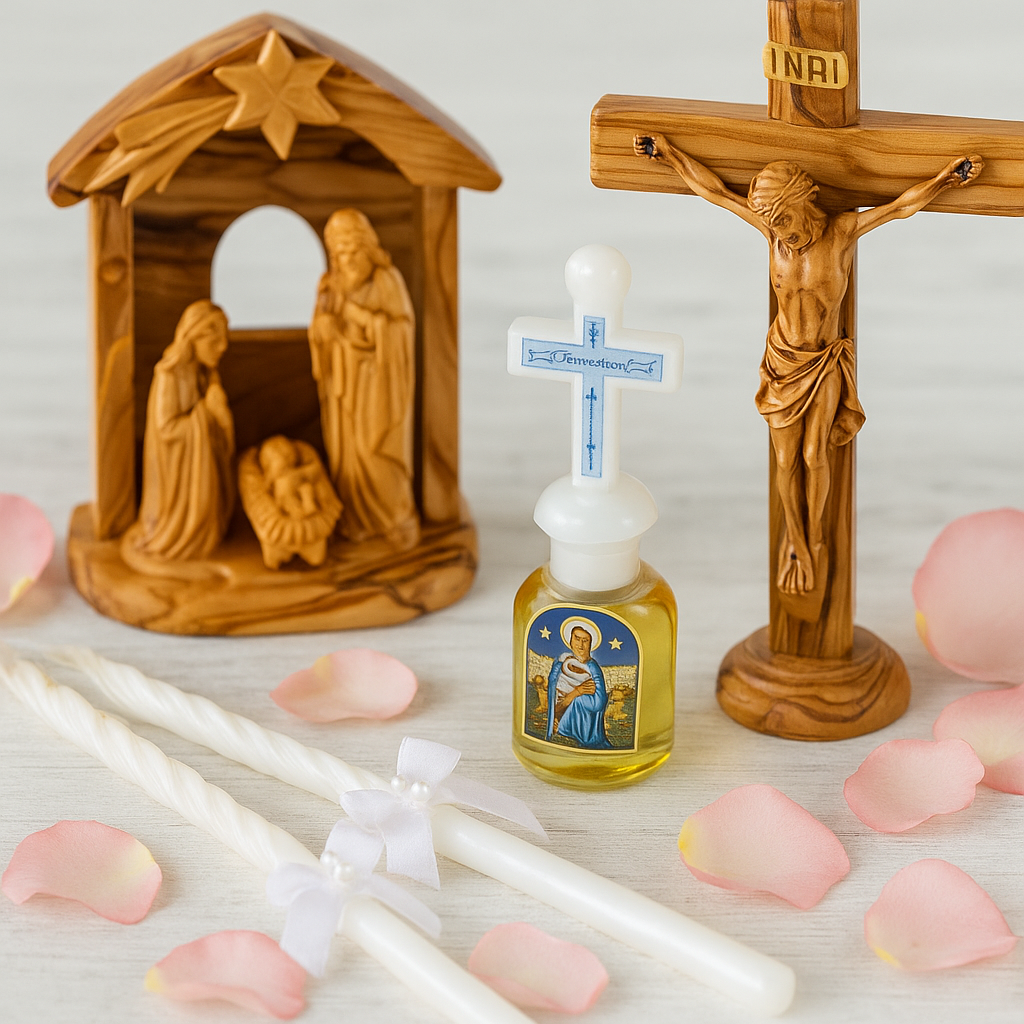
At first, it may look like nothing more than rough form and outline. But little by little, the details appear. A cross. A nativity. An angel. A heart. A figure meant to be held, displayed, gifted, or treasured. Every line is shaped with intention.
This kind of craftsmanship does not come from a machine. It comes from repetition, discipline, and years of learning. In many cases, it is a tradition passed down within the same family, from one generation to the next.
The Beauty of What Makes It Different
One of the most beautiful things about olive wood is that no two pieces are ever exactly alike.
Each carving carries its own natural grain, its own movement, its own tones and markings. Some pieces have soft flowing lines. Others have stronger contrast. Some feel smooth and calm, while others feel bold and full of character.
That uniqueness is part of the beauty.
When someone brings home a hand-carved olive wood piece, they are not bringing home something identical to thousands of others. They are bringing home one piece of one tree, shaped by one artisan, in one moment of time.
Even the smallest differences are part of what make it real. They are not imperfections. They are reminders that the piece was made by hand.
More Than Something to Display

Olive wood carvings are beautiful to look at, but their value goes beyond appearance.
A cross placed in a home can become part of daily prayer or reflection. A nativity scene may return every Christmas and become part of family tradition. A small carved figure may sit quietly on a shelf, yet still hold deep meaning for the person who owns it.
These are the kinds of pieces people keep close.
Part of that meaning comes from what the piece represents. But another part comes from where it was made. Bethlehem holds a special place in the hearts of many people around the world. Because of that, an olive wood carving from Bethlehem often feels more personal, more rooted, more connected.
It does not feel like just another item for the home. It feels like something with a story.
From the Workshop to Your Door
Once the carving is complete, the piece is carefully finished by hand. It is smoothed, polished, and brought to life in a way that reveals the natural richness of olive wood. This is when the warm color and distinctive grain begin to stand out even more.
Then comes the next part of its story — the journey.
What begins in a small Bethlehem workshop does not stay there. It travels far, crossing borders and oceans before finally arriving in someone’s hands. By the time it reaches its new home, it has already lived a meaningful journey.
Most people see the finished piece, but not everything behind it. They do not always see the workshop, the waiting, the carving, the finishing, the packing, and the distance traveled.
But all of that is part of the piece too.
Why This Craft Still Means So Much

Today, so many products are made quickly, cheaply, and without much thought behind them. That is why handmade work stands out more than ever.
It reminds people what care looks like.
In Bethlehem, olive wood carving is still alive because families continue to protect it. The knowledge is still being passed down. The methods are still being used. The work is still being done by hand, with the same pride and patience that have shaped this tradition for years.
That is what gives these carvings their depth.
When someone chooses hand-carved olive wood, they are choosing more than a beautiful object. They are choosing something connected to heritage, craftsmanship, and the human touch.
Bringing Bethlehem Into the Home
At the end of it all, what arrives in your home is more than carved wood.
It is a piece shaped by hand.
It is part of a long tradition.
It is tied to the land and spirit of Bethlehem.
And even after the journey is over, that story stays with it.
That is why these pieces mean so much to so many people.


Comments
Post a Comment